Most authors think about what their book says. Very few think about what it’s supposed to deliver for their business, their visibility, their legacy. That gap is where ROI goes to die.
The Story
She Wrote the Book. And Then Nothing Changed.
I want to tell you about a woman I’ll call Miriam.
Fifty-four years old. Two decades of healthcare leadership. She had turned around failing hospital units, mentored hundreds of nurses, and survived a burnout so profound it reshaped everything she believed about wellness and work.
She wrote the book. Every weekend for eighteen months, she showed up and she wrote it.
And when it was done when it was finally, actually done she waited.
For the speaking invitations. For the clients who would read it and call. For the doors she’d been told a book would open.
The book sat on Amazon with a handful of reviews, most of them from people she knew personally.
“I did everything right,” she told me. “I wrote it. I published it. I promoted it. And I feel like I’m right back where I started.”
She hadn’t done anything wrong.
She had just never been asked the one question that determines whether a book works not as a manuscript, but as a *asset*.
*What is your book’s job?
The Question Nobody in Publishing Asks You
Here is what the book world will help you with:
Your message. Your story. Your structure. Your cover. Your launch.
Here is what the book world almost never asks you before any of that begins:
What do you want this book to do for you?
Not for your reader. For *you.*
Do you want it to position you as the definitive authority in your field the person journalists call, the one conference organizers book first?
Do you want it to replace your sales conversations to hand someone your book and have it do the convincing before you ever get on a call?
Do you want it to open stages? Build a movement? Attract a specific kind of client you currently can’t reach? Cement a legacy that outlasts your career?
These are not the same book.
A book designed to generate leads is structured differently than a book designed to launch a speaking career. A book built to establish authority reads differently than a book built to start a movement. A book whose job is to attract premium clients has a different architecture, a different tone, a different call to action than a book whose job is to heal, to teach, or to challenge an entire industry’s thinking.
When you don’t define the job before you write the first word, you make hundreds of decisions about structure, about stories, about tone, about what to include and what to leave out with no North Star connecting them.
The book gets written. It just doesn’t perform.
Because you never hired it for anything.
What It Actually Means to Give Your Book a Job
Think about how you make every other significant investment in your business.
You don’t hire a team member without a job description. You don’t launch a program without knowing what it’s supposed to generate. You don’t build a marketing strategy without defining what success looks like.
Your book deserves the same rigor.
Before a single chapter is outlined, before a single story is chosen, before you decide on format or length or structure you answer this:
What is this book hired to do?
For your *reader*: What transformation do they experience? What do they feel, know, or do differently after the last page?
For *you*: What doors does this book open? What conversations does it start? What does it make possible in your business, your platform, your legacy that isn’t possible without it?
And critically: How will you know if it worked?
Not in sales figures. In outcomes. In the clients who reach out and say “I read your book and I knew I needed to work with you.” In the speaking bureau that calls because your book positioned you as exactly the voice they needed. In the woman who messages you at midnight and says “Chapter four changed something in me I didn’t know needed changing.”
When Miriam and I went back to the beginning and answered these questions really answered them, with specificity and intention everything about her book shifted.
Her job description became: “This book finds the healthcare leader who is succeeding on the outside and silently falling apart on the inside. It makes her feel seen before she reaches chapter two. And it makes me the person she calls when she’s ready to do something about it.”
That answer told us everything. Who the book was truly for. What it needed to feel like. What it needed to deliver for her reader and for her. The structure followed. The stories found their place. The message sharpened into something she could say in a single breath.
The intention came first. Everything else grew from it.
The Framework That Builds on That Foundation
Once you know your book’s job, you build the architecture to carry it.
This is where the B.O.C. Blueprint™ begins a three-part framework I developed for accomplished women who think strategically in every area of their lives, but have never applied that same discipline to the asset that could do the most work for them.
Book Architecture
Design the structure around the job, not the other way aroundNow that you know what the book is hired to do, you can decide what to build.
Is it a memoir? A methodology? A leadership guide? A hybrid? Each structure carries a different kind of authority, attracts a different kind of reader, and delivers a different kind of return.
This is where you answer:
– Who is the *one* specific person this book is written for?
– What do they experience by the last page?
– What format story-led, framework-led, or a blend serves both the reader and the book’s job?
– What length delivers real value without losing them?
These answers look completely different depending on what the book is hired to do. Which is exactly why the job description comes first.
Book Outline
Build the road before you drive
A real outline is not a table of contents you’ll figure out later. It is a strategic roadmap.
It answers: What does the reader need to know, in what order, and why does the sequence matter?
Three layers:
1. The macro arc – the full journey from problem to transformation
2. The section structure – the major phases of that journey
3. The chapter promises – what each chapter specifically delivers
This is also where you place your stories, your research, your frameworks – not writing them yet, but mapping them intentionally so nothing gets lost, nothing gets crammed in, nothing gets left out that the book’s job required you to include.
Chapter Design
Map each room before you decorate it
For every chapter, before a single sentence is written, you create a micro-plan:
– What is this chapter’s one central idea?
– What story opens it – and why this story?
– What does the reader feel by the final paragraph?
– What pulls them into the next chapter?
When you have this map for every chapter, writing becomes execution. You don’t show up to a blank page. You show up to a blueprint.
Miriam completed her chapter designs in a single weekend. Two weeks later, she had her first three chapters written not because she became a better writer, but because she finally knew what she was building and exactly who she was building it for.
The Question That Changes Everything
If you have already written your book or you are in the middle of writing it right now I want you to stop and answer this honestly:
What did I hire this book to do?
Not what did I want it to say. What did I want it to *deliver*? For my reader. For my business. For my life.
If you don’t have a clear answer, that’s not a failure. It’s information. It means there is still time to make intentional decisions about how you position it, how you launch it, how you talk about it, and what you build around it.
And if you haven’t started writing yet this is your greatest advantage. Because you get to begin with the question every author wishes someone had asked them at the start.
Set a timer for 30 minutes. Write your answer to this raw, unedited, without stopping:
“What is my book’s job? What do I want it to do for my reader? What do I want it to do for me for my business, my platform, my legacy? And how will I know if it worked?”
Don’t polish it. Don’t perform it. Just write it true.
That answer is not a writing exercise. It is a business decision. It is a legacy decision.
And it is the one decision the entire book industry forgot to ask you to make.
Your book is not just a manuscript. It is the most leveraged asset you will ever build.
It works while you sleep. It opens rooms you haven’t entered yet. It speaks for you at the table when you’re not in the room. It finds the exact person who needs exactly what only you can offer and it hands them a reason to trust you before you’ve ever spoken a word.
But only if it has a job.
Only if you hired it for one.
That’s the conversation we should have been having all along.
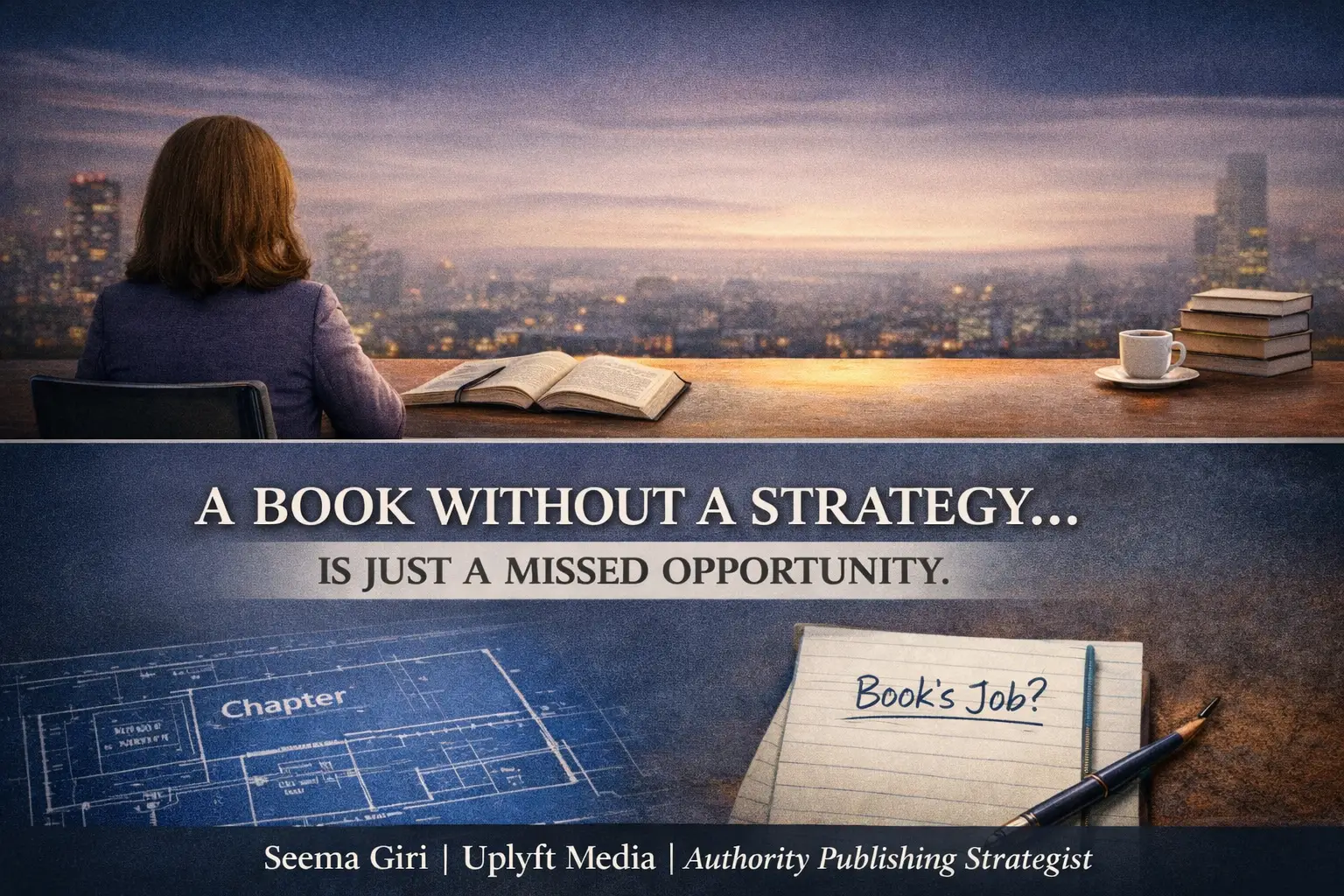
Seema Giri, Founder, Uplyft Media | Authority Publishing Strategist


0 Comments